Monday, May 21, 2012

Create A Flower Bed And Make A Good Plan

How to Create a Flower Bed

So you want to build a flower bed. Where do you begin? Before starting a flower bed, you need to plan ahead. Take a stroll around your property and choose a suitable location. Take note of available light and nearby structures. Determine the whereabouts of any underground utility lines and the nearest water source.

Flower Bed
Before you plant a flower bed, you should make a sketch. This is important, as it allows you to play around with ideas, like the size and shape of the flower bed. It will also make it easier when choosing plants, as these should always be compatible to the area. Use a hose, spray paint or flour to mark out and shape the bed. If building a raised bed, determine the type and amount of edging material as well.

Most people prefer the no-dig approach. It starts with eliminating the grass as we did in the dig methoid. While using herbicides can effectively kill grass, it may not be suitable for planting until much later, as herbicides are not environmentally friendly. However, you can easily smother grass quickly and effectively without the use of harmful chemicals simply by using cardboard or newspaper.

You can start the no-dig bed in early spring for summer planting or build a flower bed in fall, as grass begins to go dormant. Fill the area with cardboard or several layers of newspaper and saturate with water. Add about six inches of compost or rich soil on top with another layer of organic mulch (like straw) on top of this. You can plant a flower bed right away if the grass was dug out or within the next season using the no-dig method.

Choose a site. How much sun an area gets is a prime consideration. Six hours of sunlight will do for the greatest variety of plants. Stay away from underground utility lines and allow at least three feet from a building or fence.

In hot climates, it is best to have some shade from the relentless afternoon sun, so a flower bed to the east of a building or fence usually works best. This also gives some protection from the hot drying winds that usually come from the west.

You can grow a garden even if you get 12 hours of full sunlight, but you should be more careful about which flowers you choose to grow. Pick ones that love full exposure to the sun. Your garden will also need more frequent watering.

Start small. Enthusiasm for gardening is great, but can rapidly dry up when the work mounts. Start with a small flower bed, say 25 square feet, which is room for around 20 to 30 plants with perhaps three types of annuals and one or two perennials. You can always increase you plantings as your experience grows.

Make a detailed landscaping plan and dig a flower bed to fit that scheme, if you want. On the other hand, if you're no good at planning on paper, or you know about where and how large you'd like the bed, simply lay it out right there in your garden.

Laying a garden hose on the ground is one way to mark or plan a gentle curve. If you have a lawn adjoining the bed you are digging, remember to leave yourself mower access.

Start digging. Once you locate a site and mark out the boundaries with a water hose, remove all sod and pieces of grass or weeds that may re-sprout. Using a spade or garden fork, completely dig up the bed to at least eight inches deep, a foot deep is better. Remove rocks or any debris.

Buy the plants or seeds then plant according to their directions. Smaller plants go in the front of the bed. Most plants are planted at the same depth they were growing. Firm the soil around them. Remember when placing plants that they will grow, so start with extra space and read the labels carefully to see how much space to leave them.

Get a variety of flowers because they bloom at different times and this will keep your flower garden always in bloom.

Water thoroughly. Like a good waiter, a good gardener will check whether water is required before watering. How much you water will depend upon the needs of your plants, the climate and exposure, and how much rain your yard gets.

Cut spent blooms periodically. Many plants will re-bloom, but only if the old blooms are cut. Also, support and prune your plants as necessary.

Sunday, May 6, 2012

Rosemary Is One Of The Most Decorative Herbs

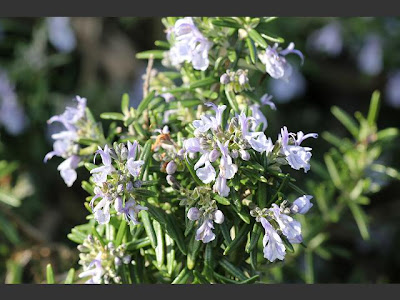
rosemary
Rosemary is one of the most decorative herbs and is well worth growing for its appearance alone. Dependent on the variety, it has small, profuse flowers appearing in late spring which range from dark blue through pale blue right down to white.
  
Although rosemary is a native plant of the Mediterranean and Asia, it is still reasonably hardy in cooler areas. Rosemary is a good choice if you want shrubs that are able to withstand droughts well. It will survive a severe lack of water for lengthy periods of time.
  
Rosemary has leaves which look like pine needles. It is these needles which can be finely chopped and used to flavour a variety of dishes, especially stuffing. Many cooks simply cut sprigs of rosemary and place many roasted meats, especially lamb, pork, chicken and turkey with great results.
  
You will make things far easier on yourself if you start with a nursery grown plant. Rosemary can take some time to fill in as a plant, so expect to pay more for a mature plant than for a small rosemary start.
  
Rosemary is usually propagated by cuttings. Seeds can be difficult to germinate and often don't grow true to their parent. It's much faster to start with a cutting and you will be sure of what type of plant you will get. It's possible to root rosemary in a glass of water, but a bit more effort will give more dependable results.Seeds are readily available from most major seed merchants, although only for Rosmarinus officinalis - we have not seen any seed for sale for the other varieties. The seeds are cheap to buy online, although propagation is erratic. Sow the seeds in potting compost around mid-May time and place in a sheltered position in the garden - unfortunately you will only achieve a success rate of about 15%. The seedlings may well take up to 2 months to appear so don't give up hope until maybe 3 months has past.
  
rosemary flowers
Where the winter temperatures dip below 30 degrees F., rosemary plants will have to spend the winter indoors. In this case, it's easier to grow your rosemary in a container all year. Since rosemary likes it on the dry side, terra cotta pots are an especially good choice. Just be sure it doesn't bake and completely dry out while outdoors during the summer.
  
Bring the potted rosemary inside once the temperature inches into the 30s. It can be a little trickier to keep rosemary happy inside. Your rosemary plant will still require 6-8 hours of full sun, so artificial lights may be necessary. Heat is not as crucial as sunlight.
  
Move your potted rosemary back outdoors once all danger of frost has passed.
  
As with most potted plants, the soil in your rosemary pot will degenerate through watering and root growth. Repot at least once a year. Spring is a good time to repot your rosemary, but it should be fine no matter what time of year you get to it.
  
When the rosemary plant puts out considerable growth or looks like it just can't get enough water, it has outgrown its pot and needs to be transplanted into a larger one. If you want to maintain the size of your rosemary plant, root prune it by slicing off a couple of inches of the roots from the bottom and sides of the root ball and replanting in the same pot. Be sure to trim some of the top at the same time, to lessen the work load of the roots and the stress placed upon the trimmed plant. Then allow your repotted plant some time to regroup. It should reward you with many more seasons of snippings.
  
The herb Rosemary grows extremely well in large pots or other containers. The pots need to be reasonably deep because rosemary is a deep rooting herb. Fill the pot with a mixture of 20% sharp sand or grit and 80% standard potting compost. Make a hole in the compost and place one rooted cutting in the middle of the pot. Water the plant well to help it settle in and consolidate the soil around the roots.

Tuesday, May 1, 2012

Enjoying The Luxurious Beauty Of The Jasmine

Jasmine
The Jasmine is a very popular flower around the world especially in the tropics because of its unique fragrance. The Jasmine is native to tropical and warm or temperate regions of the old world.
  
The Jasmine flowers are white in most species, with some species being yellow. The Jasmine is believed to have originated in the Himalayas in western China.
  
Ayurvedic Medicine. The flowers and the essential oil are two parts that can be used from the jasmine plant. They are known as jati and are used as a sattvic tonic. Sattvic is one of the three health elements that is important according to Ayurvedic principles and this element of the jasmine flower apparently emphasizes the nature of compassion and love. Hence, jati is often used as an aphrodisiac for women. The jasmine is also used to help build up immunity, and to reduce fevers.
  
Traditional Chinese Medicine. The Chinese would brew jasmine plant flowers as an infusion tea. Tea that was scented with Arabian jasmine has been made since 300 AD. In China, these flowers are known as mo li and they are widely used as a scenting ingredient. In Traditional Chinese medicine, these herbs would be placed beside heat-dried green tea, so that the green tea would absorb some of the jasmine flower scent. Nowadays, it is common to find green tea and jasmine flowers mixed together and sold commercially.
  
Flowering in Jasmines takes place in summer or spring which is usally six months after planting. The Jasmine flower releases its fragrance at night after the sun has set and especially when the moon is waxing towards fullness. Jasmine flower buds are more fragrant than the flowers.The name Jasmine originates from France and Persia, and the name refers to the Jasmine plant, which climbs like a vine and is used for making a variety of perfumes and other good-smelling products. In 1973, it was discovered that Jasmine was quickly becoming a popular name in America, and when Disney used the name "Jasmine" for one of its princesses in the movie "Aladdin," it quickly became even more of a hit.
  
There exists a true Jasmine and a false Jasmine, and the two are commonly mistaken for each other because of the fragrance the plants release. The true Jasmine belongs to the family Oleaceae and is primarily a bushy shrub or a climbing vine and is non-poisonous.
  
True Jasmines have oval, shiny leaves and tubular, waxy-white flowers. The false Jasmine on the other hand is in a completely different genus, Gelsemium, and family, Loganiaceae, which is considered too poisonous for human consumption.One of the most popular decorative teas today is the Jasmine flower tea. Aside from the highly exquisite designs that can be made from Jasmine tea flowers, you will be able to enjoy its heavenly flower aroma. So a Jasmine flower tea is not just a simple decorative tea. It is also considered as an effective component in the promotion of aroma therapy. That is because the aroma of Jasmine tea flowers has a very calming and relaxing effect on people. So you can prepare it to relieve stress that could be bothering you. You can also prepare Jasmine tea for your guests to make them more at ease and relaxed.
  
So if you want a health drink that can also serve as a decorative object, then a Flowering tea would be best for you. This type of tea is individually packed to ensure that the quality of the design will not be damaged. It is best also if you can use transparent display tea pot or cups when preparing this type of decorative tea. This way, you and your guests can enjoy the luxurious beauty of a blossoming tea and get its healthy benefits.

Thursday, April 26, 2012

The Irises In My Yard Seem To Do Equally Well In Full Sun Or In Partial Shade

irises
Claude Monet painted Irises in Monet's Garden in 1900. When he purchased the Giverny estate, Monet completely redesigned the flower garden that already existed in front of the house. He became passionate about surrounding his property with flowers, and his preference for blue and violet flowers inspired him to plant most of his spring beds with irises.

When the flowers bloomed, Monet painted them with brief, thick strokes of pure pigment. In this painting he creates the floating effect of the iris beds, described by a visitor as a haze of lilac inside the sun.

Spending time in nature and much more specifically in stunning gardens can have an extremely soothing have an effect on on the soul. Jardin De Monet also produces such a soothing impact. It truly is as if the soul were bathed in the full light of the warm summer day on which Monet produced this incredible work of art.

In 1890 Monet had bought a band of marshland above the alley from his abode and annual garden, through which flowed a accessory of the Epte. By breach this stream, he began to assemble a water-lily garden. Soon complaining willows, iris, and bamboo grew about a free-form pool, clusters of afraid pads and blossoms floated on the quiet water, and a Japanese arch bankrupt the agreement at one end. By 1900 this different artefact of Monet's acuteness (for his Impressionism had become added subjective) was in itself a above plan of ecology art--an alien lotus acreage aural which he was to meditate and acrylic for added than 20 years. The aboriginal canvases of Irises in Monets Garden and the Japanese arch were alone about one backyard square, but their aberrant accessible composition, with the ample blossoms and pads abeyant as if in space, and the azure baptize in which clouds were reflected, adumbrated an encompassing ambiance above the frame. This abstraction of all-embracing spatiality, new to the history of painting and alone absolute in the aboriginal water-lily paintings, was broadcast by 1925 into a aeon of huge murals to be installed in Paris in two 80-foot egg-shaped apartment in the Orangerie of the Tuileries. These were declared in 1952 by the painter André Masson as "the Sistine Chapel of Impressionism." This consummate accomplishment of Monet's long, acid abstraction of nature--his appetiteto cede his impressions, as he said, "in the face of the a lot of avoiding effects"--was not committed until afterwards his death. The abounding ample studies for the Orangerie murals, as able-bodied as added aberrant and different works corrective in the baptize garden amid 1916 and 1925, were about alien until the 1950s but are now broadcast throughout the above clandestine collections and museums of the world. Despite declining eyesight, Monet connected to acrylic about until his afterlife in 1926.

Irises are on the account of the a lot of big-ticket paintings anytime sold, affairs for 54 actor dollars in 1987. Currently Irises is on affectation at The Getty Center in Los Angeles, California. He alleged the painting "the lightning aqueduct for my illness", because he acquainted that he could accumulate himself from traveling batty by continuing to paint.

It was painted before his first attack at the asylum. There is a lack of the high tension which is seen in his later works. He called the painting "the lightning conductor for my illness", because he felt that he could keep himself from going insane by continuing to paint.

Monday, April 23, 2012

The Beautiful And Elegant Flower, Lily

Lily
A lily comprises of about 200 plants species in the world and some of the members are not lilies after all. The lily family are broken down into these group: Lilium -true lily,Tulipa- tulips, Hyacinthus- hyacinth, Hemerocallis- daylily, Fritillaria- checkered lilies, Convallaria-lily of the valley, Hosta- plantain lilies, Erythronium- trout lilies, Calla lilies and some of the known lilies are not actually lilies at all. These plants are not really hard to cultivate after all. You don't need to have a gift or have a green thumb to raise a beautiful one, all you have to do is to follow some simple rules and then you will have your own lily grown by your own hands.

People across the world use lily varieties for a wide range of occasions. For example, many women choose to include lilies in there weddings, often making up not only bouquets, but also centerpieces for the rehearsal dinner and reception. Likewise, some people prefer lilies to roses due to their color variety and overall beauty and fragrance. Furthermore, lilies are often given at funerals. The specific lily variety used holds different meanings, but all can be purchased at a reduced price when you buy wholesale lilies.Lilies generally start to bloom in late spring/early summer when the nights are cool and when the days are getting longer and warmer. Lilies are commonly split into two main groups: asiatics and orientals.

Lilies tend to get thin and spindly if allowed to grow in too dense shade. If shade is the problem, moving them to a a position with better sun should rectify in the problem. The problem can also be one of care. Lilies are pretty easy to care for, but you need to know the basics. Lilies which you want to come back should be fertilized two to three times during the growing period, in early spring as they poke their heads above ground, just before flowering and finally you can broadcast fertilizer over the ground in early fall.The flower essence helps in suppressing aggressive tendencies in individuals and helps in holistic healing. Tiger Lily has some toxic effects on cats and it can produce vomiting, in appetence, lethargy, kidney failure, even death. There is a superstition that smelling Tiger Lily will give you freckles, maybe started with the lily's spotted interior. And lastly, the Tiger Lily stands for wealth and prosperity.

A topdressing around the base of the plant every year with a good quality compost is also recommended. Fertilize two to three times per year. Deadhead spent flowers by removing the dead flowers plus seed pods. Do not restrict foliage, but allow the lily to grow until it turns brown on it's own in fall. If planted in 'o deep shade, move to a place with more sun. Apply a good layer of compost around the base of the lily in spring and fall, if possible.. optional. This would depend on you and what you think would be best for your lily.

Now it's ime for you to plant the bulb of the lily, depending on the species each lily has different time that you are going to plant them. One example of this is the American lilies which are advisable to be planted on mid October. When planting, dig about three times the size of the bulb and separate them seven inches apart from each other. The key here in growing the perfect lily is the way you for care it. Just like caring for your baby, the more gentle you are the better. Keep it away from over exposure to the heat and weeds. Try to cultivate the soil but do not hit near the bulb as it might hurt its roots and this will lead to the destruction of it. You can also add a fertilizer or food plant in your lily' ground to supplement it. The other way is to put mulch to help them moisturize during the hot season to keep their soil damp.